Experience After 60 Seeks Structure
Your career is complete.
Your legacy is not.
The WELLth Movement encourages experienced adults 60+ to turn a lifetime of knowledge into a legacy they actively live — through guided conversations, not courses or coaching programs.
If you're an educator, facilitator, mentor, or professional who senses there's still meaningful work to do, you're in the right place.
This is where Experience-Holders become Legacents.

Not sure where to start?
👉 Take the Start Here Diagnostic — a quick, selection-based tool. About 2 minutes.
Prefer to think it through in words?
👉 Access the Reflection Guide — a slower, guided inquiry.
Dr. Stephen Hobbs, EdD, founded the WELLth Movement in 1996 framed by 22 years as a whitewater rafting guide that taught him how experience, shared well, shifts people. He's since authored 20 books and served as Lead Instructor at the Banff Centre for Arts and Creativity. (Full story below.)

What the WELLth Movement offers four ways to work with your legacy
Understand your story. See what your life after 60 has already been building toward.
Map your legacy, in your own words. No framework imposed — just what's already there, made clear.
Walk the path. Start living the legacy you intend to leave, one step at a time.
Mentor others. If guiding people is part of your legacy, [learn how mentoring works here].
The most intentional work of your life is not behind you.
It is waiting to be organized, shared, and lived forward.
Ready to see where you are on the path?
Take the Diagnostic or start with the Reflection Guide.
Have a question first? [Reach out] — we'd like to hear from you.
Although Dr. Hobbs’ work has a very scientific edge in its proof, he is much more of an artist as he weaves a tapestry of thought and action together into a seamless living piece of artwork. I would recommend getting excited over the belief that there are immense possibilities for you and your group, and that Stephen can help you stitch them into your future reality.
Jack Riley
Facilitator_Mentor
Operations and Peopleship
This is not for everyone. It is for you.
The WELLth Movement is built for a specific person: an adult educator, facilitator, mentor, or experienced professional 60+ who is ready to convert decades of lived experience into mentoring, community contribution, and a legacy that extends well beyond a career.
If you are looking for general life coaching, this is not it.
If you are looking for a retirement plan, this is not it.
If you are looking for a structured, community-embedded pathway from Experience-Holder to Legacent — where your experience becomes something others can carry forward — you are in exactly the right place and space.
A Legacent is a person. Legacent is also a community condition.
The Legacy Transition progression
Every person enters the WELLth Movement at a different stage. Every return to any stage arrives with more to offer. This is a living pathway — not a checklist. Not a course. A progression that moves with you.
Choose the stage that names where you are right now.
1) Aging
The life stage that holds accumulated experience and wisdom. Aging after 60 is less about counting years and more about understanding/valuing them. The question shifts from "What am I doing?" to "What does all of this mean?" That shift is the doorway.
👉 Value Aging — see your experience with a fresh perspective
2) Curation
The intentional selection and organization of what is worth carrying forward. Structure is what turns experience into contribution. Without structure, wisdom stays internal. With structure, it moves — fromward, into the lives of others.
👉 Curate Next — turn what you know into something clear and usable
3) Mentoring
The relationship transmits experience. Mentoring turns your experience into something someone else can use — whether that's one person you guide, or a program in which you serve.
👉 Start Mentoring — shape how you guide others with confidence
4) Legacy
The pattern of contribution that takes root in others. Legacy is not inheritance. It is an influence that continues — through relationships, communities, and future generations. It is living proof that the work mattered.
👉 Frame Legacy — build something that carries forward
5) Legacent
A Legacent is someone who lives their legacy now, deliberately, instead of leaving it behind later. And, it is the community condition where contribution, mentoring, and legacy remain active, visible, and in circulation. A Legacent is not someone who has finished. A Legacent is someone who is living it, deliberately, fromward.
👉 Become Legacent — live your contribution with others

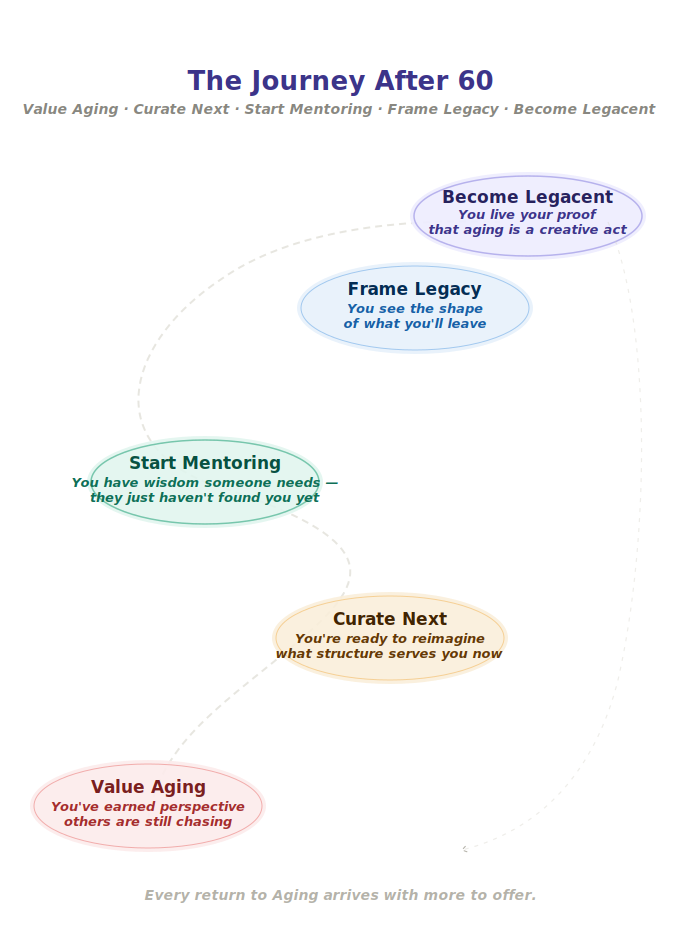
This is a progression. Not a checklist. A living pathway that moves with you.
What the Legacy Transition makes possible
Your experience already carries value. The issue was never capability. The issue is usually structure.
When structure arrives, something shifts. The weight of unfinished contribution lifts. Direction appears. Energy returns. Experience stops feeling like something to carry and starts feeling like something to move.
Through the WELLth Movement's Legacy Transition progression, you:
Recognize patterns across decades that were not visible before
Shape experience into clear, shareable forms others can engage with and carry forward
Guide others with confidence, presence, and without performance
Create contributions that carry forward through relationships, communities, and time
Live your legacy fromward — not someday, but now, in the daily practice of a Legacent
This is not about starting over. It is about organizing what has already been living within you.
What sustains you through the progression
A pathway needs more than structure. It needs the inner conditions that keep contribution alive, even when transition is uncertain, even when the next step is not yet clear.
Within the WELLth Movement, five inner conditions sustain the Legacy Transition. These are not personality traits. They are capacities that deepen through the progression itself.
Identity Knowing who you are beyond the title, role, or institution you held.
Meaning Connecting your contribution to what genuinely matters — to you and to others.
Agency Choosing how, where, and with whom you contribute — on your own terms.
Optimism Recognizing that your experience still holds irreplaceable value for others.
Resilience Sustaining contribution through transition, uncertainty, and shift.
These conditions do not arrive before the work begins. They grow through the work itself. That is why the Legacy Transition is a progression, not a program.
Built for adult educators and experienced professionals 60+
Educators spend decades helping others learn, grow, and find direction. After 60, a different invitation arrives.
The skills that made you an effective educator — deep listening, patient presence, the ability to meet people where they are, the instinct to ask the question before offering the answer — are the same skills that make an extraordinary Legacent.
What the WELLth Movement provides is not a new credential or a new identity. It is a splace — a space and place — where what you have already been living gets organized, named, and carried forward with intention.
You do not need more information. You need structure, direction, and a community that understands the work you have already done.
Begin with what suits you:
👉 Take the Start Here Diagnostic — clarity first, then direction
👉 Access the Reflection Guide — begin with what your experience is already showing you
👉 Visit the Blog — read short reflections and structured insights
👉 Explore the Store — access books, guides, and pathway tools
The Legacent behind the WELLth Movement
Dr. Stephen Hobbs did not start out writing about legacy. He started on a river.
Twenty-two summers as a whitewater rafting guide taught him something no classroom confirmed until much later: that experience, held well and shared clearly, shifts people in ways that information alone cannot. That insight became the foundation for everything that followed.
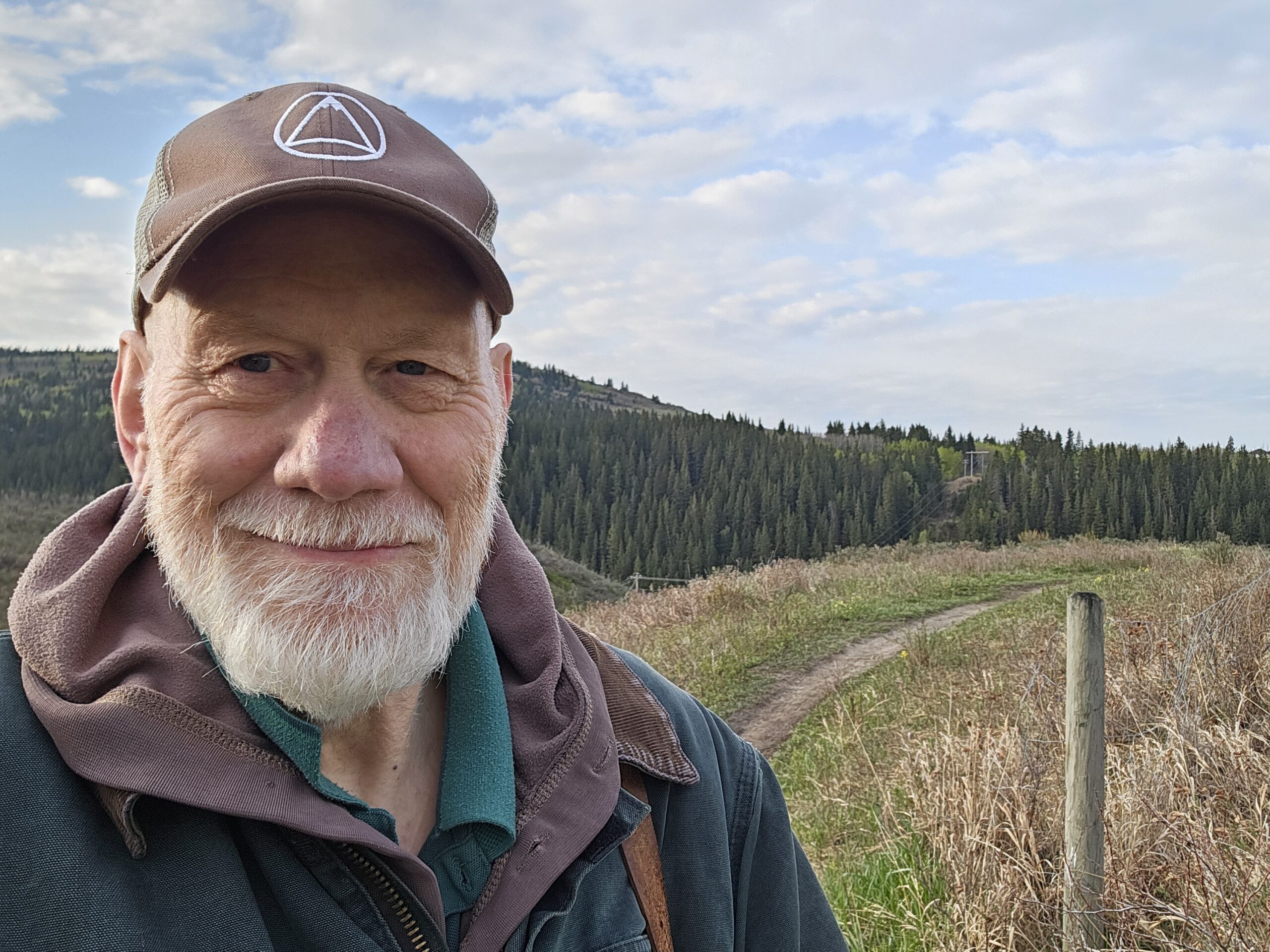
In 1996, he founded the WELLth Movement — a learning and contribution ecosystem built on the idea that the richest, most intentional work of a life begins with courage and commitment. Since then, Stephen has served as Lead Instructor at the Banff Centre for Arts and Creativity, authored 20 books (some on Amazon), trained Wilderness Remote First Aid instructors for 25 years, and spent three decades as an adult educator and facilitator working alongside people navigating the passage from achievement to contribution.
He coined the word Legacent because no existing word named what he had been living — and watching others live — for years: organizing experience into something transferable, mentoring without a title, and choosing, deliberately, to live a legacy rather than leave one.
He holds an EdD from Nova Southeastern University (1996) and lives west of Calgary, Alberta, with nature as his consistent muse, mentor, and mirror.
Every article, framework, and pathway in the WELLth Movement grew from something he has lived, tested, shaped, and shared. He is not describing the Legacent pathway from outside. He is walking it, still.
Legacy is lived before it is left.
WELLcome home, Legacent.
You belong here. There is already a place for you in this community.
Ready to see where you are on the path?
Take the Diagnostic or start with the Reflection Guide.
Have a question first? [Reach out] — we'd like to hear from you.